




photo ButcherandBuschelBanner_zps60b017ff.jpg
Showing posts with label healthy pet food. Show all posts

Wednesday, April 23, 2014

Understanding Organic Pet Food

by Carrie Boyko, CEB
courtesy USDA.org

During our upcoming #OrganicPet Twitter Party, hosted by Event Barkers team members All Things Dog Blog, ToDogWithLove.com and DogTipper.com, my primary job will be to sort out the facts from the fiction when it comes to the true meaning of organic on a food label. There are many misconceptions about what defines organic, and an equally large number of questions on many of your minds. 

I'll be on hand to share the facts about the National Organic Program, and I'll be accompanied by the social media team from Castor and Pollux. This trio will be answering your questions about their products, so make out your lists. This will be an excellent opportunity for you to get all your questions answered.

A good place to start is with the USDA Organic seal, shown above. When you see this seal on a product, whether in color or black and white, it is generally placed on the front label and is your singular confirmation that the contents of the package are at least 95% organic. You'll find this label on many of Castor and Pollux's products in the ORGANIX brand, most notably their canned meals. At #OrganicPet, we'll be discussing the newest line of these meals, Butcher and Bushel, that are produced using a newer technology which allows them to be pressure cooked inside the can. Watch for exciting news on this note as we move forward. We'll also have bunches of info on this during the party; really cool stuff that your dog is sure to salivate over.


courtesy Tilth.org
Other seals indicating a minimum of 70% certified organic content include those such as Oregon Tilth, a third party government contractor that certifies organic farming practices, products, ingredients and processing facilities. These agency seals will generally be located on the back of the product. Oregon Tilth is one of many such agencies, and happens to be the company that certifies the bagged kibble for ORGANIX. Are you asking yourself why pet parents would purchase a 70% organic product when 95% is available in canned product? That's an excellent question and one that I'd like to answer by sharing our story:


Some years ago when I began seeking an organic food for our pets, I found out the hard way what our Castor and Pollux social media team can probably tell you: It's tough to locate a reliable source for certain organic ingredients, making that 95% USDA organic product even more challenging to achieve. 
After scouring the larger pet supermarkets, I quickly learned that USDA Organic was not avaialable--at that time--via these retailers.
Next I hit the smaller natural food markets and what I call the "mom and pop" pet retailers--smaller, single store operations. I found quite a few USDA Organic pet foods that met my initial criteria, but quickly learned that continuity would become a huge problem.
Each time I returned to purchase another bag, the last brand I had served was either discontinued or out of stock indefinitely, leaving me with yet another decision to make--which new product to try THIS TIME.  This frustrating and time-consuming problem ended up to be my solution. As I chatted with the owner of one "mom and pop", she explained that the small organic pet food companies were all struggling with supply issues and that I might have better luck if I switched to an organic product made by a slightly larger company that included the 70% organic promise on their label. She introduced me to Castor and Pollux.
I sighed and began comparing labels. Who knew? I had completely overlooked the fact that these products, such as Castor and Pollux's ORGANIX, contained organic chicken, organic vegetables, organic fruits, and higher quality organic grains. "So where is the 30% that cannot be called organic?", I asked the store owner. It was right there on the label--the supplements, many that are wholefood ingredients added to provide vitamins and minerals. 
My last question for this shop keeper was the most obvious: "Which product is reliably in-stock?" Her reply was, "You're looking at it right now." I handed her the bag of ORGANIX and told her we'd be back again in a few weeks to see if, in fact, we were able to purchase the same product again. I'm sure you can guess the happy ending to this story.

The ORGANIX brand is built on a foundation of sourcing organic produce that are healthy and nutritious additions to their products. Tanner and Oliver have spent all of their lives on this organic diet, enjoying good health, shiny coats, and plentiful energy. We look forward to sharing more of the facts about organic foods at #OrganicPet.

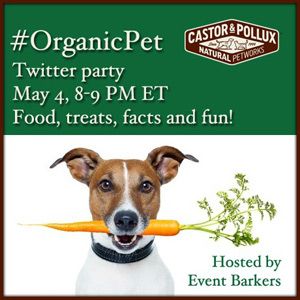
 Have you marked your calendar? Join us on May 4, 8 PM-9 PM ET. Don't forget to RSVP here using the Giveaway Tools widget, and join in our pre-party giveaways, if you'd like to take a chance at winning now.

Here's to your #OrganicPet,



Follow Me on Pinterest
SOURCES:  Facts about the National Organic Program shared both here and during the #OrganicPet Twitter Party come from the official government website for the program: www.ams.usda.gov

All Things Dog Blog works with ORGANIX to educate the public on the benefits of feeding a healthy diet. While we generally share facts based on research, opinions shared are my own. My dogs are fed the ORGANIX kibble along with treats and special-occasion surprises such as Butcher and Bushel.

Monday, January 27, 2014

Fast Fact About Pet Food

by Carrie Boyko, CEB
Buffer
Did You Know?
I hear from readers quite frequently with similar questions about the word "meal" on their dog food label. According to Wikipedia and AAFCO (American Association of Feed Control Officials), a meal is an ingredient which has been ground or otherwise reduced in particle size. That definition works for some folks, but others ask the next obvious question: What do they include in the meal?

Edible meals include clean, dry animal flesh and skin--sometimes bone. I hate to get too graphic, but I want to be clear. The process starts with whole carcasses of animal, but there are no heads, feet, entrails or feathers included. Once the meal is made, the nutritional value changes dramatically. Protein in a chicken meal, for example, is condensed to 65% with only 10% water, resulting in a healthy ingredient for Fido.

So why am I telling you all this? Look at your dog food's ingredient label. You'll often see a Chicken Meal (beef, lamb, etc) ingredient in the first 3 items listed. The purpose of this is to amplify the protein content of the food, especially when a fresh meat is included first. You see, fresh meat includes such a large amount of liquid that the actual nutritional value is limited by this water content. 

That said, if your pet food label includes a fresh (or frozen) meat on the ingredient list, it needs to include a meal to supplement the nutrition. Water is heavy, yet adds little to the healthfulness of the recipe. Since food is sold by weight, water changes nutritional readings dramatically, when present.

The well-respected Whole Dog Journal recommends that your dog food include a specific meal (Chicken Meal, not meat meal, for example) if the ingredient list starts with a fresh meat. This criteria is included as one of their "Hallmarks of Quality". Food for thought!


Follow Me on Pinterest
As an NBInsider I strive to bring you helpful information about your pet food and information and news about Natural Balance products. Read my recent article on How to Choose a Dog Treat here.

Sunday, September 8, 2013

Pet Food Categories: Their Meanings?

by Carrie Boyko, CEB
© AllThingsDogBlog.com
Our Food; Serious Business
These days a pet owner needs a dictionary or their iPhone to look up all the terms found on the pet food packaging. Even the easy stuff seems confusing to many. For example, what really is the difference between Organic and Holistic food? And what should you reasonably expect Natural food to include, or more important, not include?

If you shop at the likes of Whole Foods for your human groceries, you're probably familiar with the word Conventional. This one still frustrates me because it gives off an air of normalcy, and I don't subscribe to this sort of normal. This doesn't make it necessarily bad, but I'm sure you'd like to clearly understand how pet food companies define their terms. Let's sort out the differences here...

Conventional: This very traditional-sounding word actually means that the foods with this sort of labeling are produced using 20th century techniques for mass production capabilities. They can be laced with toxins such as herbicides, pesticides, antibiotics, synthetic fertilizers, growth hormones and artificial preservatives, all without these items being added by the pet food manufacturer. That's why we can't blame it all on them.

The scary part is that these nasties are not on the label because they are assumed. You see, these invisible layers of toxic stuff have not been added to the food in production; they were used to actually produce it--whether during fattening up the cows and chickens or growing the fruits and vegetables.

Natural:  This is an over-used term these days that baffles me as well. The intention of the word is to inform the customer that the product is minimally processed and has no synthetic ingredients ADDED as a part of processing. That does not mean that synthetics were not used during the growth or production of the individual ingredients. 

So, in case you were wondering "Does this natural food have pesticides buried inside?", the answer is probably YES, there are some residues. Sorry to bust that bubble. Reading the label is your best guide to determining if the product is free of the toxic no-no's that are on your particular bad guy list.

Organic: You may be shaking your head, having heard the rumors that this word is used loosely also. The difference is that it has more government oversight, so your guarantees are a bit stronger than with the Natural versions you thought seemed perfectly pure. But what, exactly, does Organic mean?

To be labeled Organic in the U.S., a food must have been certified under one of two levels of certification done by the U.S. Food and Drug Administration's National Organic Program. More on these levels in another post. Let's start with what's not in Organically-produced livestock and produce.

Ingredients that are specifically labeled Organic on the food label have been certified as having been produced without the use of synthetic fertilizers, herbicides, pesticides, and may not have been given antibiotics or growth hormones for production. This is not as easy as it sounds. Talk to any organic farmer and you'll learn that it's a labor of love, of commitment to the earth and our future.

An organic crop, for example, must be grown in a field that has a large barrier of non-producing land between it and any neighboring farms that may be producing conventional produce or livestock. This rather sizeable barrier helps to reduce groundwater contamination and the spread of sprays via the wind. Obviously, it's not a perfect system, but it does get the job done for all intents and purposes.

Further, these crops may not be treated with anything topically that falls under a non-organic classification. Pest control is the biggest challenge to these farmers who often report large losses due to pest invasion. 

Natural fertilizers and herbicides are increasingly more available. Thankfully these devoted organic farmers, who shepherd the earth's resources in our soil, are willing to seek out new ways to get their crops through the seeding and growth cycle successfully.

The task is even more complicated in the production of organic livestock--chicken, pork, beef,turkey, etc. Not only must their feed meet the Organic criteria, but the land that they are produced on must also be maintained by organic standards. Add to this the loss of growth hormones to speed up the fattening process and you can quickly see that animals get to market much slower using this method. I think you're beginning to understand what you pay for when you notice the higher price tag on your pet's Organic food. You get what you pay for!

Holistic is the new buzzword in pet food that confuses most of us. A while back one of my readers asked our veterinarian to address this topic and she happily shed some light on its meaning. You can read her whole post here. In short, Dr. Pat explained that this word includes an approach that involves what's better for the people, our environment and our pets. 

Often truly Holistic food is sold in recyclable packaging, the company donates a portion of proceeds to animal welfare organizations and uses healthier ingredients--sometimes organic. The downfall of this category is that with no legal oversight, the food may not be what you believe it to be. Read the ingredients label and decide for yourself if it is truly Holistic. You'll get more input on how to make this decision from Dr. Pat's article that is linked above.

Beyond these 3 more common categories, the inquisitive consumer will also find Gluten-Free, Grain Free, Non-GMO, Vegetarian and Vegan, among other specialty foods. I'll address these differences in another post. I think we've covered enough ground today.

Questions? Feel free to leave them in a comment and return for my answers. Thanks for reading!

Follow Me on Pinterest
As an NBInsider, I am compensated to share information about Natural Balance and their healthy pet foods. Today's post does not specifically address their foods, but I am obligated by the FTC to disclose my relationship with Natural Balance. This informative post is a part of my commitment to educating you on your choices, and shares not only my knowledge, but also some opinions.

Friday, May 27, 2011

Our Dogs' Food: The Big Decision

by Carrie Boyko, CEB

© Carrie Boyko 2007
Clearly This Was the Right Decision!

Our Senior, our Adult, and Our Puppy
all Loving their Chow


Every family has to set their food and health priorities, both for themselves and for their pets. Visit any pet products store you choose and you're sure to find out that there are dozens and dozens of brands to choose from. 


Even after you ask your veterinarian about food, you may still find yourself wondering, "What's best for my dog?"  The experts say it all comes down to balancing healthy sources of protein, fats, fruits, vegetables and fiber. For my family, there is the added criteria of leaving the synthetic toxins behind.

Conventional Pet Food
As I've discussed recently, conventionally produced food ingredient sources have a dirty little secret:  Produce, including meats, vegetables, fruits, and even dairy, are laced with invisible layers of toxins from pesticides, herbicides, fertilizers, antibiotics, and even growth hormones. It's these unlisted, invisible ingredients that we have chosen to avoid. 

Natural Pet Food
Your next best choice will be a natural dog food. The term 'natural' has been tossed around quite loosely. You can look it up in Wikipedia and you'll find that even these definition experts have thrown up their hands and said, "Who knows?" However, its intention is to indicate that food is minimally processed and has no synthetic ingredients added.  

Organic Pet Food
Moving on to the organically certified foods, you'll find there are 2 grades. The USDA's National Organic Program  has two levels of organic labeling. Third party certification is overseen by the USDA, and certified by a small number of highly regulated organizations. Their certifications provide confirmation of 70-94% organic ingredients in a product with their labeling. Our dog food company calls this "Natural Plus".

The next level of organic certification is, as you may have guessed, the most difficult to achieve. The USDA Organic label, earned directly from the USDA, is your sign that a product is guaranteed to be 95-100% organic. Sounds great! Let's all run out and find USDA Organic dog food...right?

Sorry to say, it's not that easy. Pet food manufacturers making USDA Organic pet food have come and gone. The stiff criteria makes this cream-of-the-crop level a hard task to accomplish over the long term.

When I went shopping for brands that I could purchase locally with good availability, I learned very quickly that changing brands regularly would likely be inherent in the decision. That wasn't part of my plan, so we chose to go with a brand of dry food that offers third party organic certification, has a U.S. production facility, and is widely available. In addition, this company's track record impressed me, along with the fact that their canned dog food was available with the USDA organic label. 

No, I don't use canned food on a daily basis. But my dogs certainly do enjoy the treats I make with it, and it's quite handy for delivering medication via meatballs. I'll be sharing some of my Fidos' favorite recipes with you, so hang in there until after I announce the Big Reveal and the product giveaway announcement—tomorrow!


HINT: If you don't want to miss a single opportunity like a terrific dog food giveaway, be sure to grab your FREE subscription to All Things Dog Blog in the dog house on our sidebar. 


Did you miss the first two installments of this series?

Full disclosure: All Things Dog Blog has not been compensated to provide the upcoming dog food review.  We have not been paid to provide our opinion of this product, and the opinion provided is our own.

Saturday, May 21, 2011

Our Pet Food Pantry--A Little History

by Carrie Boyko, CEB
© Carrie Boyko
Xena's Favorite Dog Food?
You'll Learn Soon
Since research shows that pets help us live longer, healthier lives, we need to Paw it Forward. We should be repaying our furry friends for their services. But how?


At All Things Dog Blog, we committed to this very effort in 2007, in a unique way. We cleaned our pantry and our pet food containers and hit the road to find the best organic food sources. Both Xena, our senior Retriever girl, and Carrie, yours truly, had been diagnosed with cancer. No one was going to tell us we were done!


Finding our new organic pet food was part and parcel to Xena’s treatment. With liver cancer, she needed a diet that would put little strain on her already overworked organ. Organic was the key to this goal, with no added artificial ingredients for the liver to process. She would be given a chance to outlive her slow-growing tumor that specialists told us could not be removed without serious danger to her survival.


I investigated every organic food I could find, searching the big pet superstores, as well as the small, pet specialty boutiques. Many questions and answers later I made my choice, based on quality ingredients, company history, a U.S.-based production, and one final, very important criteria: consistent availability. 


I was appalled to learn from many pet owners that had to make several switches along the way. I quickly came to the realization that I needed a company large enough to assure availability, yet small enough to get closer to its roots—healthy food sources.


If you’ve been reading my blog for a while, you probably already know I feed my dogs organic food. Yet there is one little kibble of information that I have kept close to the cuff—my chosen brand.


I’ve been waiting to unveil this very special choice. “For what?,” you may ask. It’s rather silly, I suppose, but I’ve had a goal since I started writing this blog. I always knew somewhere deep inside of me, that if this blog took off, I’d want to thank my pet food company for what they gave Xena—another 3 years of life.


That’s right; Xena lived to within days of her 14th birthday, a good life for a Retriever, to be sure. Our chosen dog food supplier will be unveiled here soon with a grand review and a big thank you.


Stay tuned as I will soon be bringing you the source of Xena’s long life. We’ll begin Wednesday with a little mini-lesson on some of the benefits of an organic diet. Join me? I hope so.


To get the fun rolling, be sure to check out our countdown site, where you can take a guess at our photo shoot wardrobe difficulties. Can you guess what went wrong? Comments, jokes and jabs are all welcome here on the blog! And don't miss our surprise announcement on the countdown site.


Just to make sure you don't miss a single segment of this series, be sure to stop by my sidebar and grab yourself a free subscription. Or you can use the dog house below. There's nothing like the ease of opening your inbox to find my posts just waiting on you. And better yet, you'll have the satisfaction of knowing you'll never miss an important post.  Happy tails!


Lest we forget, it's the Saturday Pet Blogger Hop. Please do peruse the list and have some fun bouncing. And while you're out and about, stop in at our hosts to pay your respects with a thank you: Life with Dogs, Confessions of the Plume and Two Little Cavaliers. Happy hopping.


Full disclosure: All Things Dog Blog has not been compensated to provide the upcoming dog food review.  We have not been paid to provide our opinion of this product, and the opinion provided is our own.

While we are linked up to the Saturday Pet Blogger Hop, we are also linking up to Hoppin Weekend for some extra exposure. If the code for the Pet Blogger hop does not appear, you may acquire it from the host's site at Life with Dogs. It seems to be misbehaving tonight!

Free Hot Samples

Related Posts Plugin for WordPress, Blogger...
 
Blog Design by A Mommy's Blog Design (© Copyright 2011)
Header Banner created by Bill Henderson Design