




photo ButcherandBuschelBanner_zps60b017ff.jpg
Showing posts with label dog fears. Show all posts

Monday, March 2, 2015

Ask the Dog Trainer:
Dealing with Fear of Larger Dogs

by Carrie Boyko, CEB

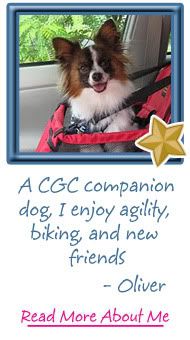
Oliver (in the middle) Joins the Big Dogs
at the Park for a Group Greeting
Dear Michael,  

I have a toy poodle that is about 7 years old. She is prissy and fearful of bigger dogs. Our neighborhood is like dog central. Mostly larger dogs but a few small ones like Chihuahuas and a Boston Terrier, plus a few crosses or rescued mutts. When I walk Muffin she is always interested in visiting other small dogs. She’s not playful but she does sniff and sort of say hello in a doggy way. Sometimes she will even stop to see a medium-sized dog like one cocker that lives around the corner. But when we see a bigger dog she will snap and growl if we get too close. I have to avoid these dogs and their owners so that Muffin doesn’t get herself into trouble. I don’t want her to get hurt. Is there a way to help her understand when a larger dog is friendly and ok to say hello to? I don’t know how to help her with this. Any tips you have would be appreciated. 

Thank you, Janet
-----------------------------------------------------------------------------------
 Dear Janet,

My heart really goes out to your little poodle. Life is complicated, so full of unknowns. I can really empathize. It’s hard to know who is safe and who is a threat. Why is he looking at me like that? Is she up to no good? Can I trust that one? While our brains are asking and processing all these questions, our emotions (think gut level) are sorting through memories and trying to fill in gaps where memories are lacking. We need to know how to handle every potential social interaction, and antisocial threat for that matter, and we sometimes only have seconds to figure it all out. It’s hard. And we are humans, supposedly the smartest animals on the planet.

Now scale all that down to your prissy little poodle (we really shouldn’t call her that, it’s not nice). But seriously, what’s a dog to think? She’s little. The big dogs, they’re really big (could be 5-10 time her size). And, who knows how the big dogs roll on any given day. One wrong choice can be fatal. For real. Better to be safe than sorry, right? Maybe that’s what she’s thinking.

But no one wants to live in fear. We can all agree on that. And you want to help, which is nice. And I want to help you, too. So, let’s sort this out.

Have your dog’s back. If you needed help with a tough situation, what would you want. An advocate maybe? Someone looking out for your best interests? A coach, perhaps? Exactly. Having your dog’s back includes two things. 1) Teaching her what do to at any given moment. I literally like to teach my dogs to look to me for instructions (like a friend asks for advice) when they are unsure of a situation. Don’t bite, don’t bark, check in with me. As you progress you can teach more advanced skills, like how to interact, sniff and otherwise greet dogs on a loose leash. The second part of having your dog’s back 2) Protect her from situations she’s not ready to handle yet. We humans are always in such a hurry. Hurry up prissy (seriously, no name calling) and get over it already. Well, let me tell you, that doesn’t work. If your dog looks unsure, steer her away from the big guys and gals. There’s no shame in that. Every growl-snap blow-up solidifies her fear and sets back your training considerably. Take your time. Work smart.

Teach her that she is safe. If you use reinforcement-based training to teach her how to handle herself when big dogs are around (look to you for instructions etc.), you can actually help her learn that she’s not in any real danger. A good qualified dog behavior consultant who understands desensitization and counter conditioning can help with this. All your dog needs to know is that you will protect her and that seeing big dogs means good things (not bad) are about to happen. Specifically, she’s going to get treats for following your simple instructions. Every encounter with a big dog comes with structure as well as your praise and treats. It’s subtle, but this teaches your dog that she’s safe (not in any real danger) when big dogs are around.

Support good choices. Let’s watch how this plays out. When you notice your dog making good behavior choices (especially when she sees big dogs), be there to support those choices. Praise her. Treat her. Smile and let her know she’s being a brave girl. Here are some good dog choices to be on the lookout for:

  • Checking in with you on her own (not barking)
  • Steering clear of the dog on her own (as you’ve shown her do to many times before)
  • Approaching the other dog slowly on her own (don’t force this)
  • Allowing the dog to sniff while she’s calm on a loose leash (your behavior coach can help you get to this level).
Oliver's Ears Tell the Story:
He's on High Alert Here
How do you measure success? At first, I look for lower intensity reactions from the dog, like less barking or choosing to walk away rather than snap. I also look for quicker recovery times from the dog, responding faster to your directions if she gets in past her comfort level and barks or snaps. In the long run, we aim for calm social interactions. There’s a lot we can do and there is help available to you. When all is said and done, though, it’s up to the dog. She may end up being more comfortable hanging with the little dogs. Maybe that’s just how she rolls.

© used with permission from Robyn Arouty Photography

Michael Baugh CDBC CPDT-KSA works with families with fearful and aggressive dogs in Houston, TX. He’s a regular contributor to allthingsdogblog.com, Chron.com and his own blog michaelbaugh.com


Follow Me on Pinterest instagram
Michael's advice does not replace an actual consultation with a qualified trainer.

Friday, August 10, 2012

Your Dog's Reaction to Distraction:
CGC Test 9 Tips & Troubles

by Carrie Boyko, CEB
Imagine a Man-Made Noise Like This

Bang! Bonk! Wham! Clunk! This is one of the most chalenging tests for many dogs whose owners seek to pass the Canine Good Citizen test. Why? Unexpected noises that are loud and sudden often startle or frighten our dogs. The goal of this test is to determine if your dog is able to settle after an initial startle, without bolting, barking, cowering, whimpering, or otherwise showing fear beyond noticing the sudden noise.

Acceptable startle behavior includes turning, backing up a step or two (no more), sitting, moving slightly away without pulling you, or looking to you for feedback. Anything beyond these types of reactions may be considered too much fear. Each evaluator will have a different take on the guidelines here, and may not agree with you on how to score your dog's reaction. While you can discuss the decision with the evaluator, his decision will ultimately be final.

I've seen some quite varying examples of this test and will warn you that you need to prepare your pup for most every kind of noise. What's worse is many of the examiners will have the noise occur behind or out of sight of you and your dog, meaning that neither of you are expecting it. So much for mental preparation. If you respond with fear, your dog will too. So preparation includes quelling your own response to sudden noise.

Here are some of the noises CGC evaluators have used at tests I have been present for:
  • Drop a metal folding chair on a cement floor from about 4 feet high--very startling!
  • Ask the handler and the dog to walk on a sidewalk along a busy roadway, without significant issue over semi-trucks and fire engine noise.
  • Release the lifting mechanism of a pallet jack and allow it to drop to a cement floor--this one made me jump!
  • While facing away from a doorway, a door was slammed hard by a third party assistant.
  • A large bell with a deep and continuous bong was rung.
  • A 2 x 4 board was broken over a firm, narrow surface. Funny, I can't remember what they broke the board on???
  • Two heavy pots banged together at their bottoms.
  • Pushing a grocery cart, walker or wheelchair directly past the test takers is a very popular approach to one of the attempts to frighten your dog.
You get the idea, right? The CGC examiner will be out to trip you and your dog up big time. It's their job to make sure your dog can take a brief startle and then settle himself without any further ado. Most test evaluators will attempt to frighten your dog twice during this part of the test, so be prepared for the second try. It will likely be a different method :)

Here are my suggestions for preparing:

  1. Walk along busy roadways frequently and get your pup used to traffic, firetrucks and semi-trailers. They are unpredicable, bouncy, and noisy.
  2. When your dog is playing in the yard, practice hitting your car horn often to get him used to hearing the noise.
  3. Obviously, you can make some noise in the kitchen. Those cooking pots are great for startling Fido. Start small and gradually build up the intensity of the "bang". Your goal is to get him to the point where he tells himself, "Oh well, it's just mom or dad being noisy again".
  4. Slamming doors (unbreakable ones, hopefully) is another excellent test that will likely be used.
  5. If your dog has shown uncertainty around any particular object, that's your cue to train with that item. You could get unlucky and have that very object used in the test, so be prepared. Start practicing by having your dog sit at the end of a room, while the object lies on the floor. Tap it gently and watch Fido's reaction. Gradually increase the movement and noise. Roll it, set it down, drop it, bang it. He needs to be ready for them all.
  6. Make use of your driveway or other cement surface by testing your dog's ability to tolerate heavy metal objects dropped on them. Start with your dog well away when it occurs. Allow him to watch so he understands that the noise is harmless. Remember that your reaction needs to be negligible also. He will begin to follow your lead. Eventually you'll want to be able to drop a really loud item right behind him and get nothing more than a head turn. Then he's ready for the test.
  7. Find a grocery cart in a parking lot and walk your dog around with it. If you do this often enough he will become comfortable with the presense of this big object. You can also practice that at pet superstores where carts are available.
Weekly Wag ButtonAll this practice will take time. Although your prep class may only last a few weeks, these sessions of readiness should begin by 6 months and continue until you take the exam. If you discover a new noise, go toward it and see how Fido responds. Watch for everything that could trip him up and help him learn to accept it as safe, based on your calm reaction and lack of response. Remember, do not soothe or coo over your dog if he shows fear. You'll only be encouraging it. Ignore him and walk to the object showing no fear. Show him by example that this object is harmless. Time will embed this lessen and he'll get the idea. You've got his back!

Catch up on the earlier parts of this series here:

Introductory Tips to Getting the Canine Citizen Certification
CGC Test 1: Accepting a Friendly Stranger
CGC Test 2: Sit Politely for Petting
CGC Test 3: Appearance and Grooming
CGC Test 4: Walking on a Loose Leash
CGC Test 5: Walking Your Dog Through a Crowd
CGC Test 6: Sit/Stay or Down/Stay
CGC Test 7: Come When Called
CGC Test 8: Reaction to Another Dog


Join us each week for the Weekly Wag bonding series, held during the Saturday Pet Blogger Hop. The hop is hosted by Life with Dogs, Two Little Cavaliers, and Confessions of the Plume. You are welcome to link up here, or check any of their sites for their rules of participation. Happy hopping!

Tuesday, April 10, 2012

Ask the Dog Trainer: Velcro Dog

by Michael Baugh, CPDT-KA, CDBC

© All Things Dog Blog
Independent Play?

Dear Michael:

I am going to need help on this for Skipper. Skipper was in obedience classes twice 6 weeks each. He would never sit and stay and let me walk away. I would take a baby step backwards and he would take a baby step with me. I would put him back and it was the same thing all over. He did get a little btter and I could take maybe 6 steps. Skipper is our rescue and was abused. Skipper was 6 months old when we drove to Nebraska to pick him up. We were his 3rd owners. The first owner never got him his shots and was taking care of him. the second family got his his shots but could not keep him because he chewed everything up plus he was in a small kennel all day and out just for a short time in the evening and back in the kennel. They also had an older female Vizsla that was a hunting dog. I saw the ad in the paper and contacted the lady. We made arrangement to meet them in a park in nearby the Nebraska/Iowa state line. We took Schooner with us to make sure they would get along. Skipper name was Bo we changed the name because he needed a boating name and it had to start with an "S". Schooner and Skipper saw each other and took off running and playing. What a great match. So they offered us the kennel and I said OK we would take it but when I saw the little kennel that Skipper was in I said no. I don't know how Skipper could even turn around in the kennel plus the end of his tail was rubbed raw. I felt like crying for Skipper. Schooner has a brother and it was a perfect match for both dogs. Skipper is a very Velcro dog and needs to be right beside my husband, myself or Schooner all the time. So if you have any ideas for Skipper let me know.

Thanks, Sharon
-------------------------------------------------------------------------------------


Hi Sharon,

Thank you for taking Skipper into your home and into your heart.  You’ve done a great thing by rescuing him.  I know you’re going to do great things with his training too.

The main things here are making independent thinking and action both safe and fun for Skipper.  Look for opportunities to praise Skipper for getting it right, and let him know you’re his biggest fan.  Reading your post about Skipper’s friendship with Schooner made me wonder.  Do he and Schooner ever romp and play away from you?  If so, cheer that on. I might also consider putting “go play” on cue.  You do that by telling Skipper and Schooner to “go play” right when you think play is going to break out anyway.  Make it seem like it’s your idea.  In no time at all they’ll start responding to the cue to “go play” just like any trained behavior.  This encourages independence and fun time away from you.

You’ve worked on stay and I bet you can master it with Skipper.  Take it slow.  Work on building Skipper’s endurance just a step or two away from you.  Don’t go for a great distance quite yet.  See if you can build Skipper’s confidence to the point at which he could sit or rest a short distance away for 5 minutes or so.  Reinforce him periodically with a treat and some praise. Such a brave boy you are Skipper.

I really like to teach dogs how to “back up” as a game.  The dog gets reinforced for increasing distance between himself and you.  The game builds confidence and keeps the dog from getting under foot (not a bad combo).  I found a couple of examples of “clicker training back up” on youtube.  The easiest one is to simply step into Skippers space.  When he backs up even a step, click and treat.  After a dozen or so repetitions you can add the cue: “back up.”  Pause.  Then step into his space.  In time, he will simply take a step back when you ask him to.

In all his training I might recommend you reinforce him (deliver the treat) a foot or so away from you.  This will teach Skipper to sit and down outside of your personal space and not directly against you.

Of course, there is a time for closeness.  Nothing is more rewarding for a dog like Skipper after a job well done than a little cuddle time.  And who can blame him.  At the end of a long day you’ll find me right on my sofa, spooning Stella or Stewie, with just a hint of a contented smile, and the Velcro hardly visible.

© Robyn Arouty
Michael and Stella
Houston Dog Trainer Michael Baugh CPDT-KSA, CDBC is the Director of Training and Behavior at Rover Oaks Pet Resorts. Michael's advice does not replace an actual consultation with a qualified trainer.

Check out Michael's Archives Page, or these recent articles:


Wednesday, February 22, 2012

Ask the Dog Trainer:
Target Train to Solve Problems

Michael Baugh CPDT-KSA, CDBC
Refrigerator Snuggles for Xena

Dear Michael: I just wanted to touch base with you about your recommendations for Sarah and her fear of the refrigerator. She won't walk by it!

Thanks, Michelle S.
-----------------------------------------------

Thanks for your question, Michelle. Fear usually has one of two sources. 1) Unfamiliarity with the person or thing the dog is afraid of or 2) Some sort of bad prior experience with the thing or person. Regardless of the cause, your solutions are the same.


First, decide whether or not you really need to teach Sarah to conquer her fear of the fridge. This may seem silly, but give it some thought. I have a client dog who developed a phobia of his water and food bowl. That’s serious because the dog has to drink and eat to survive. Does Sarah really need to pass by the refrigerator? If so, let’s solve the problem. If not, let it go and watch to make sure the fear doesn’t spread.


Remember this when you begin training. Sarah should always have the freedom to make choices. Don’t force her to walk by the refrigerator and certainly don’t drag her past it. Instead, you’ll be incrementally reinforcing her for taking one, then two, then three steps, and so on. Clicker training will really come in handy here.


Here’s how you turn the task into a game. Teach Sarah to touch a flat object you can place on the ground. I sometimes use the lid of a Tupperware container. This is called a target and the process is called target training. Each touch of the object results in a click and a treat. This quickly becomes a fun game for the dog – touch; click; treat. Once Sarah gets hooked on the game, place the object a bit nearer the fridge. Touch; click; treat. Yay! Repeat the game with the target a little further down the path past the appliance. Eventually you’ll place the target at the end of the path and Sara will run right by the fridge to touch it. In the meantime, remember to keep the training sessions short and be patient.


Fear of appliances and objects in the household is not terribly uncommon in dogs. They’re foreign and often make strange sounds. These sources of fear are less common in humans. I sometimes wish I were more afraid of the refrigerator. It’s the bathroom scale that really scares me.


Houston Dog Trainer Michael Baugh CPDT-KSA, CDBC is the Director of Training and Behavior at Rover Oaks Pet Resorts. You may reach Michael at the link for a personal consultation, or write to him at our Ask the Dog Trainer Column @ LetsAdoptaDogPark@gmail.com. Michael's advice does not replace an actual consultation with a qualified trainer.

Check out Michael's Archives Page, or these recent articles:


Monday, July 4, 2011

Fido and Fireworks:
Helping Him Hold it Together

by Carrie Boyko, CEB
© Carrie Boyko
Am I Celebrating Noise or Bright Lights?


Tonight's the night--fireworks factory finale. After this the fireworks makers get nearly a six month break until distribution for New Years kicks in. What a great business, huh? Not so much for our Fidos though. Many dogs are frightened by lightening, thunder and fireworks. Our Xena was definitely on this list. She had a particularly odd habit of needing to climb on top of tables and desks. The higher she could get the better. We soon learned that escorting her to her crate ("Go Nite Nite, Xena") EARLY was the best strategy. 


I've learned a few things since those first years and yes, I'd like to share them with you. Tanner and Oliver are another story entirely, so here's the benefit of my successes, just for you:

  • Plan ahead and use your preventive methods proactively: Thundershirt, Calming Collars and Through a Dog's Ear (Music to Calm Your Canine Companion) are all great therapies for helping to quell Fido's nerves, yet they each work better when started early.
  • Another tactic that must be started early is vigorous exercise. Here's the plan I like best: Take a long walk in the morning. After rest, get a long swim or fetch game going, or perhaps some mind games or indoor training if rain slows your outdoor plan down. Later, take another walk, run or dog park romp to assure a fatigued mind and body. This all adds up to less re-activity to noise and stress and a calmer pup during tonight's festivities.
  • Choose a room for Fido's evening hang out that has few, if any windows. If he is comfortable in a crate, this is the best place for him to calm himself. Taking your pup to the crate early may be a good plan for preventing the "freak out" that often starts with the first of the loud noises. Offer a safe, durable chew toy for your dog to work out her nerves on. Add a blanket or dark covering to keep the fireworks lights from spooking him. Close any shades, curtains or blinds.
  • Now that you've played the relaxing music for several hours today, place the player next to his crate and turn it up louder. Volume will help dull the outdoor noises, or at least confuse them with other worldly sounds. A TV or radio is also an acceptable substitute.
If only I could take Tanner around to visit all the anxious dogs, allowing them to soak up his "what's the big deal" attitude. I have a theory. He was born in Florida during the peak of Thunderstorm season. I'm guessing he learned early on that thunder is just noise--not unlike that which he hears any other day of the year, but perhaps a bit louder and less predictable. Thankfully, he's clueless and it's business as usual for Tanner on nights like tonight. 


The even better news is that Oliver, having absorbed a small amount of nervous anxiety from Xena, is now learning some better ways to calm himself. Between the techniques above and 'clueless Tanner' for a housemate, Oliver is getting a grip. And that's a very good thing.

Happy Independence Day. Hopefully your pup will be able to be independent of you tonight as you enjoy some celebrations of your own.


Related Posts Plugin for WordPress, Blogger...
 
Blog Design by A Mommy's Blog Design (© Copyright 2011)
Header Banner created by Bill Henderson Design