




photo ButcherandBuschelBanner_zps60b017ff.jpg
Showing posts with label dog crates. Show all posts

Monday, February 28, 2011

Dog-Safe Travel, Around Town and on the Highway--Part I of III

by Carrie Boyko, CEB
© courtesy K. Litz
Pounce Travels
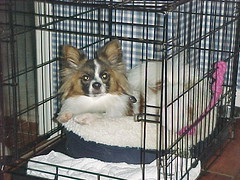
Comfortably in his Crate


Years ago when Xena was just a pup, I dutifully got her a doggie seatbelt. Xena wore her seatbelt in the back seatfor quite sometime until one day--one scary day--I had to slam on my brakes. 


After that day, she rode with me less frequently on highway expeditions, and more often on my errands to the bank and other drive-through pickups nearby. Slower speeds around town became the mainstay of her car rides. When I did take her to Grandma's or otherwise out of town, she would travel in her crate, tucked snugly in the back of my SUV--a necessity with 3 kids to run carpools for. It wasn't her favorite place to ride, but she soon became accustomed to it, especially when I added a soft bed to the crate bottom. 


I have to give her credit; she always worked with me during periods of change. When Tanner joined the family, Xena decided that the crate was pretty nice digs, now that she had a companion--albeit a whipper-snapper--to keep her company. By the time he rivaled her size, we had taken on an out of town project to manage. The dogs and I did a good bit of traveling for nearly a whole year. We logged a bunch of highway miles and also learned that two dogs in one crate could mean knocked heads. 


My solution to this dilemma was a second crate. My SUV became a Retriever-mobile, with the back seats folded down eternally, and two crates taking up much of the rear cargo area. (Didn't Pounce's mom get creative with her space in the picture above?) Thankfully I was down to one kid at home by that year, so we were able to make this work as family transportation, as well. After a tough year I hadn't bargained for, everything bundled into a bunch of stress that needed to be unleashed--pun intended! 


Soon I discovered a nearby doggie daycare through a friend and began leaving the dogs at Bow Wow Resort on my traveling days. I found that this was a safer and more productive way to manage my days out of town. The downside was that I missed my travel buddies, even though they traveled in a crate in the back. They had provided nice companionship that I missed; it was time for another change.


After the beginning of All Things Dog Blog, I met a new friend through the blog. The owner of Pet Auto Safety, has introduced me to safer options that I never knew existed. Join me for Part II of Dog-Safe Travel, as our journey to safer traveling continues. I'll share our newest travel choices for Oliver and Tanner--more secure and flexible, yet more convenient than ever. Even Tanner has some positive commentary over at 5 Minutes for Fido. See you soon.


*Just as with young children, the front seat is not your best choice for Fido's transportation. Even if Fido is seat belted with a crash-tested safety belt, he is still susceptible to life-threatening injury by an airbag deployment. With most automobiles equipped with front seat airbags, this seat is only safe for pets whose weight does not engage the airbag. Elevated car seats relieve the seat-bottom of the pet's weight, disengaging many newer car's airbag systems for front passenger seats. Check your auto manual for information on your own vehicle's airbag operation before making any decisions. 


Visit Be Smart. Ride Safe.
Need a travel crate? Amazon has over a 1000 different sizes, types and colors. Click here to shop:


Top Blogs Digg! Pets Blogs all things dog Dog Blogs - Blog Catalog Blog Directory blogarama - the blog directory Blog Directory
Help protect our precious dog parks
© Carrie Boyko, all rights reserved

Enter your email address:


Delivered by FeedBurner
Follow All Things Dog at Twitter    Find me at Facebook    Dog Blogs - BlogCatalog Blog Directory
© copyright Carrie Boyko, all rights reserved
Delicious
Bookmark this on Delicious

Wednesday, July 21, 2010

Dogs Don't Leave Home Without It: Necessities for Summer Day Outings

by Carrie Boyko


(c) Brent Boyko
Tanner is Ready to go to the Beach
We do lots of fun things outdoors. Since we love to do things outdoors, we're going to be bringing you a series of "Dogs Don't Leave Home Without It" tips. For day outings in the summer, like when you go to the park, on a country drive, hike in the woods, a picnic or beach visit, don't leave home without:
  • Lots of cool water and a bowl for the pups. We have these cool water bottles that have a fold-out bowl, perfect for thirsty dogs. You can also get the collapsible ones and the pop up kind. Whatever works for you and your dog.
  • I give the dogs ice cubes in the car, so they don't get everything all wet when they spill the bowl. Tanner, being a Retriever, likes putting his paw in the bowl.
  • Pop up nylon crates with mesh windows are great for a safe and bug-free nap time, or if we visit a friend's house and have to leave the pups behind while I run an errand without them. It's good to have the crates to make my friends feel that their houses are safe, even though my pups don't chew on furniture. More on that later!
  • Our battery operated fans hook onto the crates and have their own stand, so we can all stay cool in the shade, when we stop for a rest. I carry 3 in the car, along with extra rechargeable batteries.
  • Spare necessities that we always carry in the car for emergencies are: leashes to replace lost or broken ones, a 1st aid kitneem oil spray to repel mosquitoes, peppermint oil spray to repel ticks, and cedar oil spray to repel fleas. Can you tell we don't like bugs or boo-boos?
  • I don't tell the dogs I have these, but I keep a stash of chew strips that are good for their teeth, hidden in the glove compartment for long car rides.
  • My AAA card and a cell phone are a necessity for getting help, just in case we have car trouble or can't hike the rest of the way. I also keep my health insurance card handy--just in case. I suppose a credit card would be a good idea, in case of an emergency.
  • Finally, although they all have microchips, they also wear a collar with name tags and phone numbers. 
I'd love to hear from  you if you have more additions for my list. Tanner has added a few things to the list over at 5 Minutes for Fido. He's quite miffed with me over a few of my apparent omissions; hope you get a good laugh when you read his column.


Soon, I'll bring you some additional 'Don't Leave Home Without It' lists: errands, out of state trips, winter outings, and more. All you folks from up north should send me your ideas for the winter outings list. I'll need major help with that one. Ideas?
Help protect our precious dog parks
© Carrie Boyko, all rights reserved

Enter your email address:


Delivered by FeedBurner
Follow All Things Dog at Twitter    Find me at Facebook    Dog Blogs - BlogCatalog Blog Directory
© copyright Carrie Boyko, all rights reserved
Delicious
Bookmark this on Delicious

Tuesday, May 25, 2010

Why You Shouldn't WALK Your Dog Every Day

by Carrie Boyko
© Alan Boyko
Biking Your Dog
A Completely Different Sensory Experience
Did I get your attention? That was a pretty radical title, designed to get you dog exercise enthusiasts all riled up. I hope it worked, because now I'd like to show you why your dog needs more than a daily walk. Come along for a little ride with me:


Have you ever biked with your dog? Perhaps this is not a possibility for you. Neopolitan Mastiffs need not apply; Teacup Yorkies might not be able to keep up. It's okay. However, as the owner of a toy breed, Papillon, and a 70 lb. Golden Retriever, among my pack, I can tell you that biking is a very different type of stimulation for your dog. It reaches down to their DNA and reminds them of their ancestors chasing their dinner, herding the farm stock, or pulling a sled. You might find it hard to believe your toy breed could be motivated to pull a sled, yet my Pap would most certainly surprise you; he is a better sled dog than my Golden. Surprised? I was too.


All this said, the message is that walking is, at the very least, just a mild form of exercise. After a 3 mile walk, your dog's heartrate may be elevated, and he probably met a few pups along the way and enjoyed some pleasant, enticing smells. But this will never match the excitement of an invigorating run.


Runners can tell you about the 'runner's high' they get when the endorphins are released and they feel like they can run forever. I have not found this to be the case with my dogs, and yet they never sit and say "I'm done."


No, I'm not recommending that you run or bike with your dog every day. Their joints and ours need rest and down time. What I am suggesting is a variety of types of exercise, to heighten all of your dog's senses, giving him a well-rounded endurance experience.


A visit to an off-leash dog park is on a whole different level. While each dog's energy and activity is different, you can encourage exercise in a lazier pup with a ball-chucker, Frisbee or other favorite toy. Just be aware that it may not come home with you. Occasionally another dog will take ownership of your toy and not give it up. Good luck with that! You can minimize the damage to your wallet by sticking to FETCH with a tennis ball.


I've left the best part of dog park visits out. While your dog is exercising off-leash, he is getting a sense of what it is like to not be contained--no yard, house, car, small fenced yard or crate to keep him from getting to the dogs and humans he wants to meet.


My pack seems to enjoy the social atmosphere at the dog park just as much as the physical freedom. They may dream of a leash-free world, but remember that in that fantasy world there are many humans, as well as dogs, for them to befriend. This is a healthy socialization experience that you cannot get on a leash. The dynamic of a restrained dog greeting is different for most dogs. Any canine behavior expert will tell you, most dogs have some form of barrier excitement--the extreme need to run up to a passerby--dog or human--and greet them.


Am I telling you not to practice socialization skills on a leash? Absolutely not! That's where it should begin. But where? The answer is anywhere, or perhaps everywhere--everywhere that dogs and owners walk together.


As soon as you begin leash training with your new boarder, it is time to start your regular visits to places like Petsmart, Petco, walking trails, and dog-friendly areas of all types. Save the first dog park experience for when your pup is fully innoculated, well-socialized with people and dogs on a leash, and confident in his greeting behavior.  A well-mannered dog knows that giving and accepting a canine greeting sniff at the back-end is the only acceptable hand-shake in the dog world.


I'll be back another day to discuss more exercise options, not to leave out swimming, of course. For now, get out and give your dog some variety. His behavior will change markedly as a result, and you will be pleased. I guarantee it!


Related Reading:


Backpacks aren't Just for Students and Hikers
Biking with Your Dog: Fun and Fitness for Both of You
Swimming isn't Just for Lab Lovers
Teaching Your Dog to Fetch


Enter your email address:


Delivered by FeedBurner
Follow All Things Dog at Twitter
Find me at Facebook
Bookmark this on Delicious

Friday, March 26, 2010

ASK THE TRAINER: Why Crate Train Your Dog?

Find me on Facebook   Follow me on Twitter   Write to Dr. Jacki, ASK THE VET
(c) photo copyright Judith Joseph
Isn't Nap Time Grande?

Dear Judy:

My husband and I are planning to adopt a dog soon, partly for our son, and also for me to run with. We have decided to get a puppy, so we can bond with it from a young age, and raise it with proper house manners. He is worried about house training.

I have read about crate training and understand why it is good for the dog and the family. What I need is help for my husband to understand the reasoning, the long term benefits of using a crate, and the how tos in the beginning. Can you give us a crash course to supplement what I have read?

Thanks, Amy


-----------------------------------------

Dear Amy:

Though crate training is not as controversial today, there is still a stigma attached.  Some owners aren’t sure whether crating is good, or if it’s “inhumane”.   It is inhumane to leave a dog crated for long hours every day. However, proper crate training and usage provides dogs a safe, warm, and comfortable space.

At first I was opposed to crating, but my observations when working with dogs routinely crated was that they loved their crate, their “space”, and they felt safe from the unknown within it.  My experiences with crate training dogs of all types revealed a recipe for success.  The key ingredient of that recipe is The Introduction.  Your dog should form a positive association with the crate from the very beginning. Developing a negative association with it could result in a barking, scratching, yelping nightmare.

Good Reasons to Crate Train Now:


  • If used properly, crates are a quick and effective way to potty train pups and older dogs, as they prefer not to toilet in their bed.
  • Young pups need training before having run of the house. As hard as you and I try, we can't keep our eyes on them 60 seconds of every minute.
  • A crate is a safe play area for an hour or so when he needs to be out of the way so you can see about a baby, or your children, work your home business, do household chores or gardening, prepare dinner, shower--you get the idea.
  • You won't have to "unteach" bad behaviors learned while you were not looking, like eating household plants.
  • When you must leave him, crating protects your home from doggie damage. No coming home to torn pillows and chewed table legs. He will learn house manners easier with no bad chewing habits to break.
  • Dogs develop a "den" lifestyle, choosing to retreat to their crate when they are tired or want to relax.
  • Crates provide a secure spot in the car when traveling, preventing your dog from jumping around while you drive.
  • Crating him while entertaining at home allows your dog to be present, but not in the way. No wagging tail knocking over drinks or wet nose sniffing chips and dip.
  • Crate trained dogs are especially appreciated by pet professionals. They don't usually bark, scratch, or yelp when crated at the veterinarian's office, doggie daycare center, or dog salon.


    (C) photo copyright Carrie Boyko 2009
    Oliver Enjoys the Safety of His Crate
    In short, crate trained dogs learn to appreciate down time in their own private space, out of mischief and the activity of the household.

    For tips on crate training and answers to common questions such as “what type and size crate to purchase”; “how to use crate for potty training”, “when not to crate”; “how to cure a crate barker”; and “where to put the crate”, visit Total Control Dog Owner Assistance .

    Good luck,

    Judy
    ASK THE TRAINER Columnist


    Judith Joseph, D.O.I.


    ASK THE TRAINER at All Things Dog Blog
    Send your questions to:
    For more information on Judith Joseph and her training, you may find her at TCDOA Dog Training. A personal appointment will likely provide more specific information on your dog's issues and your questions.

    by Judith W. Joseph, DOI, Professional Dog Trainer

    Enter your email address:


    Delivered by FeedBurner

Sunday, September 6, 2009

Yorkies Can be Houdinis Also

My husband's cousin has an adorable little Yorkie puppy. It seems that Yorkies can also have talents such as Tanner's for escaping all manner of restraint:


Tuesday, September 1, 2009

Dog Etiquette: Considering Others When You Travel

Find me at Facebook
© photo copyright Carrie Boyko 2008


Jacque Sleeps Soundly
in his Travel Crate
with his "Blankie" from Home

I am planning a trip to visit family soon, and intend to take one or two of the dogs along. They enjoy car trips and travel well. In preparing for this, I remembered some dog owners' horror stories. A few of these disasters could easily have been avoided with the right preparation.

While checking for accommodations on Dog Friendly, a travel accommodations site for pet owners, I found these few tips on doggie etiquette. I'd like to add a few of my own. I'll throw in some travel tips too:
  • Never travel without a crate, even if your dog does not usually sleep in one. Strange places, smells, sounds, etc. can create a bit of anxiety in your dog. A crate with a pillow that smells like you or your dog will give him a bit more comfort and less anxious concern over the change of surroundings.

  • Speak with your vet about treatments for nausea from car or air sickness and anxiety.

  • Prior to a trip, feed only minimally, and only if your dog is not usually one to get sick during travel. You can provide treats occasionally as you travel, to keep his tummy rumbles at bay.

  • Rather than providing water during travel, pack a lunchbox-sized cooler with ice cubes. If traveling by car, drop ice cubes into his travel crate periodically, to assure he gets adequate fluids.

  • When you travel by plane, remove water at least one hour before departure. Limit fluids to less than his usual intake for the time you will be away from an appropriate potty spot. Be sure that you have his travel crate lined with an absorbent towel, just in case.

  • Be sure to bring along a health certificate if you are crossing state lines. Many vets charge a small fee for this, but regular "customers" might get them free. Fortunately, my vet provides these free.

  • Pack enough food, treats and poop bags for a few extra days, just in case your trip is extended unexpectedly.

  • Choose a few of your dog's favorite toys to pull out on occasions when he needs brief entertainment.

  • If you must leave your dog in a friend or family member's home while you go out for several hours, use the crate to assure the safety of both dog and owner's home. I always travel with baked cow bones or kongs, and fill them with dog food. When frozen, they provide hours of enjoyment while your dog is in a crate. The bones cannot be eaten, but the frozen dog food can be licked and dug out of the crevice for quite sometime.


  • While I know that the link above indicates that dogs should not be left alone in a hotel room, I would offer this advice, when necessity requires it. In the absence of a temperature controlled vehicle with a crate, many dog-friendly hotels simply ask that you place your dog in a crate, if he must be left behind for a brief period. Be considerate of neighboring rooms, if you know your dog is a yapper. Consider asking for a room in the back of the hotel, for instance. Finally, place the "Do Not Disturb" sign on the room door whenever you leave your dog, to assure he will not accidentally be released from his crate by a brush of the vacuum cleaner. If you own a Houdini, consider an extra hook closure to assure your pup does not escape his crate on his own.

  • Prior to leaving your dog for several hours, always take the dog on a long, brisk walk or perhaps a jog. A tired dog will naturally want to rest when invited into his crate. Don't forget to praise and treat him each time he enters his crate, and whenever you return to find him happily well-behaved inside his crate. This will reinforce his good behavior, making future outings increasingly easier.

  • Finally, if you plan a day's outing, beyond the capacity of your pup's bladder control, here's my advice. When my daughter and I took Oliver out of state once, we found called a few vets, asking about pet sitters that they could recommend. One had a vet tech who liked to pet sit on her day off. She took him in to play with her little Miniature Poodle and the two had a wonderful day. It could not have worked out more perfectly.

Friday, July 31, 2009

Dog Proofing Your House

Jacque Must be Watched Carefully
While Playing with his Toys

I know. I know. You're probably thinking, "Is she crazy?" I have a Chihuahua and my neighbor has a Great Dane. How can she possibly tell us both how to dog proof in one short post? Okay, you're right. It probably won't be that short. Here goes:

Dog Proofing for your Small to Medium Sized Dog


Anything from a teacup Yorkie to a Cocker Spaniel may not appear to be tall enough to get something dangerous off of your kitchen counter, right? Think again. Dogs are smart. I've seen my Papillon jump from a chair seat to a table top and from the bed to a dresser top. So keep in mind that if something appeals to your dog's nose, he'll often figure out how to get to it.

Now that you know where I'm coming from, I'll share some of the things I've done to protect both the dogs and our possessions from danger:


  1. Start with the area of your home that your dog(s) is allowed to spend time in and be sure it is as secure as possible. Can he jump your baby gate or open it ? Has he mastered opening doors or getting over or around furniture you thought was a deterrant? Tanner can open Oliver's crate and our child-guard latched baby gate. I wouldn't have believed it if I hadn't seen it myself. We've renamed him Houdini. Check out my post on the other amazing slips he's performed.

  2. Now start with this area that your dog calls his own. By this I mean whatever part of your home your dog has full access to. Starting at floor level, check all cords and cables. They should be slid under furniture and rugs or between tables and couches. In other words, not accessible to anyone other than a teacup pup that can go most anywhere a cockroach would travel. If your tiny one likes to go after things under the couch or other low pieces of furniture, you'll have to take extra evasive action. Duct tape the cords to something that is not of interest to your dog's chewing instincts, or use PVC piping for a conduit. The latter is your best bet for cords under a bed, couch or other low furniture.

  3. Now check your under the bed storage. Assure that all containers are made of hard plastic, not cardboard, and their lids snap on securely. Do not store food in these, no matter how secure they may seem. A family I once knew lost a dog when it found their chocolate stash under the bed, all wrapped up for the holidays.

  4. Next check your wallpapered areas for tears. One little corner pulled up is like a giant invitation for a chew-fest.

  5. Do the same thing with mop boards and wood trim along cabinets. Secure them and fill in holes that might encourage chewing.

  6. Inspect your dog's toy box or basket regularly for chewing evidence. When one area tears, this will lead to larger pieces coming off. This is a safety hazard, as is a chunk out of a toy. Check the toys as well, ensuring they are all safe for continued play.

  7. Check your carpets and rugs for snags, pulls, loose fibers, etc. Some will require snipping to keep the pup's interest at bay. Others may need to be stitched down or pulled through to the bottom. Be particularly diligent in watching rubber-backed rugs for chewing. If the rug is rumpled when you come into the room, turn it over and inspect it for damage. You'll know if Fido is finding this rubber backing interesting.

  8. Anything stuffed can spell digestive system blockage if your dog chews it open and ingests the stuffing. This means pillows, toys, chair cushions and children's stuffed animals and dolls. Until your dog is past his interest in such things, these should be placed well out of reach. Stuffed dog toys should not be left out except when you are supervising, at least until you know your dog's tendency to destroy or simply carry these toys. Every dog is different.

  9. Every desktop, counter top, table and other surface will contain a plethora of potentially dangerous "toys", in your dog's eyes. Common items such as pens, pencils, clothespins, hair clips, jewelry, razors (Wow!), flatware, matchbooks, computer supplies such as flash drives and camera chips, batteries, medications, knick-knacks, candles, houseplants, flower arrangements (live, silk, or dried), headphones....okay, that's enough. You get the idea. Place all these smaller items in containers, boxes, baskets or jars--out of reach. *** NOTE: Last weekend Oliver pulled a quickie on my family when we looked the other way for a few moments. He quickly devoured a bowl full of cherry pits that we were eating--cyanide filled cherry pits that can kill a dog. Long story short, we spent the afternoon inducing vomiting and then running to the emergency vet when that didn't work. Keep a close eye on your snacks!
Here's some more anecdotal evidence of the danger I'm concerned about. A few years ago when my daughter was preparing for a Homecoming Dance, she had just shaved and laid down the razor. She was right there, so what's the harm? Tanner came out of nowhere and grabbed it; by the time we caught up with him, he had a bloody mouth. The razor was nowhere to be found. We assumed he swallowed it and rushed him to the hospital. During the X-rays, the razor was found under a chair in a corner of the house. Dogs know when they're not supposed to have something, so they tend to hide it from us while they play and investigate our neat stuff. Beware!

Now let's continue with your dog proofing expedition, moving on to the concerns for the bigger dogs with access to more areas:

  1. Food. I'm sure you know, but your kids may forget. No food should ever be left anywhere but the refrigerator or the pantry, which should always be closed. I lost an entire plate of thawing chicken breasts (thankfully, boneless!) to Tanner's nose, despite having surrounded them on the counter by larger, heavier items--a barricade of sorts. It didn't work. Now I use the oven or microwave if something needs to sit out for a while.
  2. Laundry areas and laundry baskets may or may not be accessible to your dogs. If they are, your clothing is at risk, as well as the dog. Intestinal blockage is serious business, often requiring surgery. If your dog likes clothing, get a covered hamper.
  3. Trash is another thing that needs to be secure. Indoor trash cans with click open lids or releases you can tap with your foot are ideal.This is important in all areas of your home, not just the kitchen. Bathroom discards can be deadly for a dog, as can many items in an office or play area.
  4. Children's toys are extremely appealing to dogs. If your kids are messy like mine were as youngsters, you'll need to be diligent about closing their bedroom doors and play areas off. Your only alternative to neatness or closed doors is plenty of secure storage space in your kids' rooms. Good luck getting them to use it.
  5. Now let's talk about your big dog's toys. You probably already know that it isn't safe for him to play with your toy dog's balls or small toys. These items are a choking hazard for a larger dog. If you have large and small dogs in one home, you'll have to devise a system for keeping your big dog out of the little dog's toys, at least until he learns the rules. Extremely small toys that are appealing to your big dog should be kept out of his reach except when your toy dog is playing with them. Supervise this play carefully, for the benefit of your bigger dog, and offer him some exciting "big dog" toys to keep his attention. It's sometimes a juggling act, but very important.
  6. If you have a dog who is protective of your home, you'll need to have an area that he can be safely and happily secured in when visitors come. Crate training is the ideal, since your pup will know this is his down time. Offering a special filled kong toy or other safe treat will keep him busy while you visit with your company.
  7. A quick aside here: Some visitors may find your dogs annoying or even frightening, especially if they are jumpers. Your guests' comfort level with your dogs is important if you'd like them to visit again, so consider this along with the safety issues. Enforcing rules like "off the furniture" or "no jumping" is something that requires much time and practice to master. I speak from experience on that one.
  8. The garage can be an exceptionally dangerous place for your dog to explore. Keeping him out when you're working in the yard or on your car may be challenging, if you enjoy allowing your dog to join you outside. Many dog owners do. If your garage is like the typical American version, it is a storage area. It's all that storage that you'll need to review. Cleaning solutions, yard chemicals, car products, sharp tools, trash, plastic trash bags, extension cords that are plugged in, recycle bins, and much more can all be hazardous to your dog. Inexpensive plastic shelving units can be purchased at most hardware stores. These are stackable and secure for heavy items, so you can place all your potentially hazardous stuff in bins on shelves out of reach. If you have a Great Dane, out of reach will be much higher up than it will be for your Chihuahua, but that's the price you pay for a 175 pound couch potato. Tanner's best friend at his doggie daycare is a beautiful harlequin Great Dane, and I'm a huge fan. But I know that Zeus can put his paws on my shoulders and give me a kiss on my forehead with no problem. That's no easy task for most dogs, as I am 5' 10" tall. Moral of the story: store according to your dogs' ability to reach; then add 6 more inches for good measure.
With this post, I hope to have accomplished one thing--make you aware of some of the household dangers to your dog that you may have not previously considered. There are probably plenty more. Send me your tips and I'll post them in an addendum. Your thoughts are often helpful to me. Keep those comments and emails coming. I love hearing from you.

Thursday, July 2, 2009

Thunderstorms and Fireworks: Helping Your Dog Cope

One of the most common dog issues I run into is that of fear of thunder and fireworks. "First Alert Xena" is my thunderstorm alarm dog. She must feel the vibrations in the ground, because she can alert us to a storm coming far before tour weather alert radio sounds its annoying alarm. They should hire her!

As soon as Xena begins to show anxiety, I know what's coming. She only has this one phobia, so it's easy to read her. Here are the steps we take at my house to calm the crazy beast BEFORE she destroys the house:


  • First and foremost, if I know there are storms coming, I try to get her out for a long walk before she gets tense. She won't go outside, if the sky is gray, so I have to beat her to the punch.
  • Tiring her out goes a long way to helping her stay calmer. Not CALM, mind you, but less anxious. There's a fine line there.
  • In the wild, dogs who are anxious about thunder, burrow into the ground, digging a den to hunker down in till the storm passes. We have created a sanctuary much like this with a crate in a dark room. We learned long ago, that windows don't cut it for Xena. She needs darkness and the crate to settle herself.
  • Turning on music, fairly loud, is a strategy we have used in the past. It may help some, but because she seems to sense the storm from the ground, it isn't as helpful for Xena as it might seem. Try it with your dog. If it helps, that's great.
  • Finally, the attitude with which we handle the situation is an important component. No affection or soothing "poor baby" stuff. That would just encourage the behavior. We matter-of-factly take her to her crate and close the gate. Departing without affection is part of how we show Xena that this stormy noise is nothing to worry about. It's sort of like leading by example.
  • Knowing she is contained helps her to calm herself, and she'll settle into a corner of the crate and wait it out. Food, water, toys and chewies are all forms of affection that have no place in this scenario. Xena will ignore them anyway. Some dogs might take them, and assume (of course, this assumes that a dog can assume) this is encouragement of their anxious behavior. Not a good idea.


Good luck getting through the Independence Day weekend. I hope these tips help you and your dog to manage the fear factor. If you'd like to learn more techniques, you might check out this book. I've heard good things...
Related Posts Plugin for WordPress, Blogger...
 
Blog Design by A Mommy's Blog Design (© Copyright 2011)
Header Banner created by Bill Henderson Design