




photo ButcherandBuschelBanner_zps60b017ff.jpg
Showing posts with label dog nail care. Show all posts

Wednesday, March 12, 2014

Ask the Vet About Dewclaws

by Carrie Boyko, CEB
Buffer
You Want a Picture of My What?

Dear Dr. Julie,

Thank you for providing valuable information on All Things Dog Blog. I would like to understand more about Dewclaws, their purpose, meaning and potential problems:
  1. Some say that the presence of dewclaws has meaning. Can you shed light on this?
  2. Do Dewclaws have any usefulness or purpose?
  3. Are Dewclaws dangerous? Should they be removed? I hear that some are, but do not know why.
Thanks, Ken
--------------------------------------------------------------------------------
Dear Ken,

Great questions, not without controversial answers.  I’ve read that the practice of removing dewclaws began 100-150 years ago by German breeders. To this day, some breeders advocate dewclaw removal to create the “clean line” appearance of a straight front leg, in other words, for cosmetic reasons. 

I need to explain that there are two different types of dewclaws—commonly called “floppy” and “attached”.  Floppy dewclaws usually occur on the hind legs of dogs and are only attached to the leg by skin.  These nails are loose and freely moveable, increasing the risk of them snagging on underbrush or carpets.  Although some breeds require them for showing, most vets (including me) recommend removal of floppy hind dewclaws at time of spay or neuter (if it wasn’t done at 2-5 days of age).
A Healthy Dewclaw
Nice and Short

Attached dewclaws, by contrast, are typically present on dogs’ forelimbs and are connected to the leg by bone.  I never recommend routine removal of “attached” dewclaws. 

Why?  Dewclaws do have purpose.  My dog uses his daily when “holding” a rubber bone to gnaw.  Anatomically, dewclaws are equivalent to our thumbs.  More significantly, there is growing evidence that front dewclaws help stabilize the leg and prevent torque on the main joint near these dewclaws, called the carpus (which is equivalent to our wrist, or a horse’s knee).  The forces applied to the carpal joint are most pronounced in canine athletes, for example lure coursing greyhounds, agility dogs threading through weave poles, and flyball dogs making sharp turns at a gallop. 

However this notion of the dewclaws contributing to carpal stabilization is controversial.  Many orthopedic surgeons deny a connection, but others admit that dewclaw removal does seem to increase the incidence of arthritis development in the dog’s “wrist”.  One study showed that cutting a tendon in the leg that attaches to the dewclaw did produce degenerative joint disease in the carpus, supporting the connection between dewclaws and stabilization of the dog’s “wrist”.  To summarize, there is no documented proof that removing the front dewclaws of dogs as a routine procedure results in any benefit, but there may be evidence of the opposite. 

Finally, please remember how important it is to provide routine nail care for your dog.  Forgotten dewclaws can grow around in a curl and embed into the dog’s skin. 

Every day I go to work I see patients with problems resulting from long nails.  Here’s more information on trimming yourdog’s nails, which includes a video tutorial.  

Dr. Julie Buzby is a homeschooling mom of seven, American Veterinary Chiropractic Association and International Veterinary Acupuncture Society certified holistic veterinarian, and passionate advocate for canine mobility.In her free time she serves on the Advisory Board for The Grey Muzzle Organization. She can be found at Twitter @DrBuzby and on Facebook.com/ToeGrips. You'll also find more of Dr. Julie's posts at our Ask the Vet Archives page.

You may also enjoy reading her recent articles:

Dr. Julie's opinion or advice does not replace an actual exam with a veterinarian.
Follow Me on Pinterest

Friday, October 7, 2011

PediPaws Pet Nail Care Winner
Grabs Prize for 7 Pets

by Carrie Boyko, CEB
© courtesy Amazon
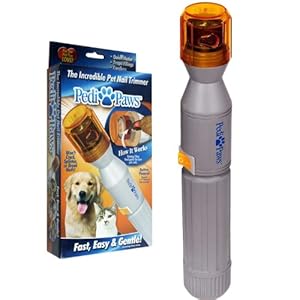
Who knew how popular the PediPaws home nail care product would be? Quite honestly I've found it to be a useful tool, while others have told me they gave up on getting their pets to allow its use. I suppose it all boils down to methodology. 


My post on how to use the PediPaws is at this link. I hope those of you who did not win will consider a Pedipaws. It's an inexpensive solution to nail care and great for smoothing those big dogs' nails out after a clipping that leaves them sharp and scratchy.


© courtesy Amazon
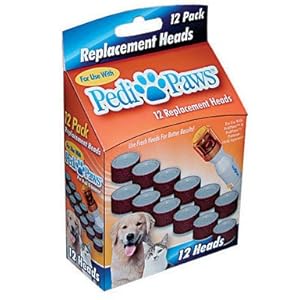
This giveaway comes complete with a box of 12 replacement heads, so our winner is sure to be set for quite sometime. That winner is Amy Orvin. Thanks for entering our giveaway Amy. We're happy you'll be able to care for your pets' nails at home, especially when I read that you have 5 cats and 2 dogs! That's a houseful for sure. 


How to train 7 pets to accept the Pedipaws gracefully? Start with your "Leader" in the group--the one the other pets follow. Good luck. I'll be in touch to request your shipping information. Happy tails!


Full disclosure: The products being given away today were not provided by the manufacturer. I have not been compensated to offer this informational post or to provide this giveaway. The information offered here is from my own experience. Visit the following link to read my full giveaway rules if you wish more detail.

Sunday, May 2, 2010

ASK THE VET: Strategies for Caring for Your Dog's Nails


Dear Dr. Jacki:

Oxnard,--my mastiff, has very heavy nails. I get them clipped at a groomers because they are so hard to do. Anyway, when they are clipped they are very sharp for a long time. Sometimes he scratches himself and creates scrapes that get inflamed. A couple of times recently he scratched so much he opened up a wound and it took a long time to scab over. The groomer told me to use Bactine on it.

My question is this. Should I get his nails ground. I hear it leaves them smoother, but I don't really know if it is safe. I also wonder if it will scare him. What do you think?

Thanks, JJ
***************************************
Hi JJ….I have a few ideas that may work for Oxnard.  After the nails have been clipped at the groomer, it would be nice to walk him on asphalt or concrete as this will help to smooth them a bit.   Actually, walking dogs on concrete (sidewalk) or asphalt really helps the nails stay nice and short. 


Some groomers offer ‘Dremeling’ which is done using a type of tool.  This is probably the best way to grind the nails down but it has to be done by someone who knows what they are doing.  The tool can get very hot and cause pain on the nail for the dog.He may be scared initially but he will get used to it.  Maybe you could call around and ask different groomers if they Dremel nails or not.  If you cannot find anyone, continue walking on the concrete.  Good question!

Good luck, Dr. Jacki


Dr. Jacki, D.V.M.
ASK THE VET on All Things Dog Blog


For more information on Dr. Jacki and her practice, you may find her at  4 Paws House Calls. A personal appointment will likely provide more specific information on your dog and your specific questions.


Dr. Jacki's opinion or advice does not replace an actual exam with a veterinarian. 
 

***************************************
If you are interested in doing this yourself, please be sure to get proper instruction:


Want to read more of Dr. Jacki's ASK THE VET columns? Here's a few links:


Enter your email address:


Delivered by FeedBurner
Follow All Things Dog at Twitter    Find me at Facebook     Dog Blogs - BlogCatalog Blog Directory
Related Posts Plugin for WordPress, Blogger...
 
Blog Design by A Mommy's Blog Design (© Copyright 2011)
Header Banner created by Bill Henderson Design