photo ButcherandBuschelBanner_zps60b017ff.jpg
Showing posts with label leash training. Show all posts

Wednesday, September 19, 2012

Train Humane Worked for Us!

by Carrie Boyko, CEB
© AllThingsDogBlog.com
Me and Jacque...Bonding
I've been working with this fella on his walking skills. He's my mom's adopted Papillon, Jacque. You've probably seen him here before. 

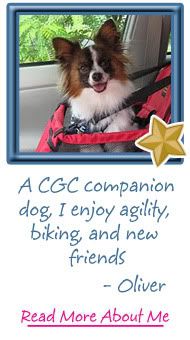
We're doing well at getting better walking manners. Oliver loves to set the example, and Jacque is getting the message with the help of his Walk in Sync system. This humane training method assures that I can't harm his neck, as many can. Join us on September 27 for more information on Train Humane Day. 

Thursday, November 17, 2011

LeashLocket: Review and Giveaway

by Carrie Boyko, CEB
© Carrie Boyko
Getting Ready for the Walk 
© Carrie Boyko
Elastic Attachment
I've made no secret of my concerns about retractable leashes. That's my disclaimer. However, I recently discovered that I can and do find the LeashLocket to be a useful tool for certain specialized applications. So, as I backpeddle on my previous notes, I'll explain why and how you can use this tool to your benefit.


If you and your dog enjoy hiking in the woods, a retractable leash allows you to give Fido some exploratory distance, without losing him to a scent among the trees. Of course any retractable leash will do this. What's special about the LeashLocket is its unique collar attachment feature. This is what won me over.


© Carrie Boyko
LeashLocket Attaches
 to Collar
Hidden inside the package and out of view is the sturdy, elastic collar attachment. This can be removed and placed around any width dog collar. It has a heavy-duty snap that attaches to the collar and a magnetic snap that connects to the LeashLocket, holding it securely on your dog's collar until you need it again. It removes quickly and easily to allow you to give up that headache of carrying your dog's leash while he plays, or locating a place to store it safely. 


Why would you want to attach the leash to Fido's collar? I can think of quite a few times when this may be handy:
  • You've arrived at the dog park and are wary of hanging your leash on the fence while you and Fido play. Simply attach the retracted LeashLocket to his collar and you can both be off and running.
  • If Fido's leash is connected to his collar and danger or excitement approaches, you can quickly grab the handle from his collar. It will release immediately and you now have control over the situation.
  • When you arrive at your destination with Fido, and he is no longer required to be on leash, you don't have to worry about where to put the leash. Simply attach it to his collar and when you're ready to leave, there will be no more seeking out your original stash.
  • I have to admit the handle is very comfortable to use. I have small hands and am reviewing a large LeashLocket, so I had my concerns about the comfort of using this handle. These concerns were quickly quelled when I grabbed it from Tanner's collar as a friend approached with his dog. I found myself examining the shape and realizing that it mimics my hand and therefore works perfectly without the typical loop handle.
  • A traditional loop handle is available for purchase on LeashLocket's site. For those who prefer their standard leash handle, this easy-to-attach handle can be hooked to the loop on one side of the LeashLocket, allowing you to hold the loop the way you may have become accustomed. This loop, being small and easy to store, will not diminish the advantages of the product significantly. It can easily be stashed in your pocket or hooked to a belt loop. I would not recommend attaching this loop to your dog's collar or leaving it on the LeashLocket, as there may be safety issues with this.
  • Having spent a couple of years in agility training with Tanner and Oliver, I can see how the LeashLocket may have some uses there. Basic training in agility often involves the use of a short leash on and off; sometimes that leash must be stowed. This storage position will allow it to be quickly used when needed without the additional step of reattaching it to the collar.
  • Finally, the large LeashLocket may appear heavy, but actually weighs only 4 oz., while the small LeashLocket weighs just under 3 oz. 
Here's a nice video to give you a little better idea how easy-to-use this product is:


If you don't see the Rafflecopter entry form here, simply click on the post title and it will reappear just beneath this line:

Tuesday, November 1, 2011

Ask the Dog Trainer:
Working with Barrier Frustration

by Michael Baugh, CPDT-KA, CDBC
 courtesy reader submission on file
Gangster
A Halloween Photo Submission
Dear Michael:


Let me start by saying that my dogs are very friendly. They love to play with other dogs and are extremely friendly with all people that they meet. My younger dog has a peculiar behavior whenever he is restrained (leash, car, house, fence) that I cannot figure out. Over time my older one is beginning to pick up this behavior also. I would like to do something about it but my trials have not gotten me anywhere.


Gangster, the large younger mix is a lab mastiff hound of some sort. He's a big friendly oaf that loves everybody. If I remove him from his leash when he barks at another dog on a leash, he melts into a new best friend of the dog he was barking crazily at. I do not understand this and need someone to explain it. Because he is so big, many people avoid us and don’t want me to take him off leash to say hello to their dog. If I allow him to say hello on leash, the other dog is often unsure of his energetic barking and will react either with fear or aggression. Help, please!
---------------------------------------------------------------------------- 
Dear Reader:


You just described one of the most common, yet vexing, dog training behavior problems of our day.  Author and trainer educator Jean Donaldson calls it the on-leash cycle of aggression.  A lot of dogs have it, and it can be very serious.

As you’ve already noticed, all behavior is dependent on the environment.  On-leash Gangster looks like an outlaw maniac.  Off-leash he’s every dog’s best bud.  It’s important to remember that behavior isn’t something inside your dog.  Behaviors are actions (like barking and lunging) that happen in the real world.  They might be problematic, but they aren’t personal, and they aren’t a character flaw.

Jean Donaldson suggests that the on-leash cycle of aggression begins with owners trying to maintain control of their young dogs on leash.  When a curious fellow pulls toward another dog, the well-meaning owner may pull back.  He may even say “no” to correct the behavior.  That alone can be punishing to some dogs.  At the very least we think it’s uncomfortable and frustrating.  Here’s where we humans get in trouble.  Dogs sometimes associate consequences (like a yank and “no”) with their own behavior (pulling on leash).  More often, however, they associate that unpleasantness with the sight of another dog.

In a short time, our dog might start anticipating a jerk on the leash and some scolding every time he sees another dog.  To avoid the discomfort, he may bark at the other dog to make him go away.  Of course that leads us to correct the dog again, which only makes the problem worse.  Pretty soon, the cycle is in full swing.  Every time our dog sees another dog, even at a great distance, he comes unglued.  Get out of here dog; this guy’s about to yank the heck out of me.

I’m not suggesting, dear reader, that you’ve ever intentionally hurt Gangster.  This is just the way the process often works.  Sometimes it doesn’t take much to get the cycle going.  Most of the time, we never even know we’re doing it.  As you mentioned, even a fence or other type of barrier can be frustrating enough to begin the cycle.  (What Gangster wants to be locked up?)

The good news is, most reward-based dog trainers can easily help you get Gangster back on the straight and narrow. 
  1. Continue to let your dog play off-leash with other dogs.  
  2. Inter-dog socialization is important for your dog’s entire lifetime. 
  3. Refrain from using prong or choke collars. 
  4. Teach your dog to walk nicely on leash and pay attention to you while walking without pulling on their leash. 
  5. Try using a Gentle Leader Easy Walk Harness if you need immediate relief from pulling.  
  6. Teach your dog to sit and attend to you on walks.  
  7. Reinforce this behavior with special healthful treats. 

Since you are catching this early while Gangster is still young.  I bet before long the only thing he’ll be stealing is hearts.  There’s no crime in that.

Michael
© Robyn Arouty
Houston Dog Trainer Michael Baugh CPDT-KA, CDBC is the director of training and behavior at Rover Oaks Pet Resorts. You may readch Michael at the link for a personal consultation, or write to him at our Ask the Dog Trainer Column @LetsAdoptaDogPark@gmail.com. Michael's advice does not replace an actual consultation with a qualified trainer.

Check out Michael's Archives Page, or these recent articles:

Helping a Fearful Dog
Adding Another Dog to Your Family


Friday, May 21, 2010

Managing Your Puppy's Endless Energy

by Carrie Boyko

(c)Carrie Boyko, all rights reserved
Get the Ball Out? 
Are You Kidding Me?


Let's face it, your first couple of months with a new puppy is going to be challenging, no matter how perfect your puppy may turn out to be. This post is designed to help you with just one of the many challenges a puppy will present: his seemingly endless energy. Here's some tips:
  1. Physical exercise is key: Long walks, runs, and vigorous playtime will all result in a tired pup who needs to rest. This will be your chance to get something else done.
  2. Mental energy needs to be drained also. This can be done with training exercises, practicing discipline like 'stay', and challenging toys that encourage your puppy to develop problem solving skills. In the photo above, Oliver tries to remove the ball from he tube; this is a wonderful problem solving toy that doubles as a chew toy--totally indestructible for Oliver's small teeth, yet soft and satisfying to chew on.
  3. Treat balls are another form of problem solving that also will keep your pup following the ball around the floor, as he tries to figure out where the yummies are coming from, and how to get them flowing faster. And what a hoot to watch a pup with a treat ball. They never bore of this toy.
  4. Leash training should begin as soon as your pup comes home. Walks will begin as short laps around the block, encouraging your little one to follow you with sweet talk and an occasional treat to keep him moving. Gradually add to the length as he begins to follow you eagerly.
  5. Safe chewing toys such as Kongs, some ropes, Nylabones, and filled ceramic bones all serve the same purpose; I call these busy bones. Anything safe to chew that will occupy your puppy for 15 minutes or more is a good way to tire him out while he's in his crate or you need time away from him.
  6. Always remember to reward and praise your puppy when he behaves appropriately. If you leave, and then return to find him quietly resting in his crate, make a big deal out of it. Lots of affection at these times will help to get the point across: this is what you want from him.
Related Reading:


Help protect our precious dog parks
© Carrie Boyko, all rights reserved

Enter your email address:


Delivered by FeedBurner
Follow All Things Dog at Twitter
Find me at Facebook

Dog Blogs - BlogCatalog Blog DirectoryDelicious Bookmark this on Delicious © copyright Carrie Boyko, all rights reserved
Related Posts Plugin for WordPress, Blogger...
 
Blog Design by A Mommy's Blog Design (© Copyright 2011)
Header Banner created by Bill Henderson Design